Because the long head of the bicep crosses the shoulder, the fully lengthened position is behind the shoulder joint, and only a cable or a preacher setup will load you there. Use a cable curl for the lengthened range, a dumbbell curl for the mid range, and a hammer curl for the brachialis. The single thing that decides whether curls hurt your elbows is alignment: the shoulder, elbow and wrist have to sit in one line, which for many lifters means going single arm and leaning.
The bicep has two heads, a long head and a short head. Looking at fiber direction, one sits to the outside and the other to the inside. The main responsibility of both is elbow flexion.
The long head crosses the shoulder joint, which means there is action at the shoulder, and that expands the range you have to train. The fully lengthened position for a bicep is actually behind the shoulder joint with the elbow fully extended. The fully shortened position takes it through shoulder flexion with the elbow flexed behind the head, as far back as you can get.
For most people that is not very far behind the head, partly because of how much external rotation access they have. That is your end range, and it is individual.
So the plan is straightforward. Choose movements that train every portion of that range, and in all of them the action you drive is elbow flexion while the shoulder position stays static.
| Movement | Where it loads the bicep | Notes |
|---|---|---|
| Cable curl | Lengthened, upper arm behind torso | The range a dumbbell cannot reach |
| Dumbbell curl | Mid range | Resistance profile matches the strength curve |
| Preacher curl | Close to fully lengthened | Second or third in the session, never first |
| Hammer curl | Brachialis and brachioradialis | Replaces the need for a reverse curl |
Almost all curling elbow pain traces back to one thing: the shoulder, elbow and wrist are not in a line, so the load is not travelling in the direction the joints actually work.
Take a bigger lifter standing straight up with dumbbells. The path is not in line, it sits out from the body, so the curl travels on a diagonal while the load comes straight down. That mismatch creates a moment arm from the elbow to where the load is applied at the hand, and that torque is exactly where medial elbow pain comes from.
The test is your own external rotation. Put the arms straight forward and externally rotate as far as you can. If you can keep the elbow in line with the wrist and the shoulder, a bilateral dumbbell curl is perfectly fine. If you cannot, and a lot of us cannot, a bilateral curl is not your movement.
The fix is to go single arm and rotate the torso out, so the palm can face straight up and the force drives straight through the hand into the joint properly. A leaning single arm version does the same thing. I see the aligned version more often with smaller competitors, and the leaning single arm alteration is what everyone else needs.
There is a second alignment check specific to cables, and it is the one people skip. From the front, the cable should run straight through the elbow and fall directly along the forearm into the hand. If you are offset, the cable pulls the hand sideways and loads the elbow medially. The side view tells you about loading. The front view is where you make sure the injury profile does not start.
A standing dumbbell curl loads preferentially in the mid range, and the reason is mechanical. When the forearm reaches 90 degrees the moment arm is at its largest, so you have the most torque at the joint and the greatest internal tension on the bicep. As the dumbbell comes up the moment arm shortens and you lose resistance, which matches the fact that a shorter bicep cannot produce as much force. That is a good strength curve and resistance profile match.
What it does not do is cover the lengthened range, and that is the honest limitation of the movement.
The execution error to fix is the elbow. Watch from the side and you will see people drive the elbow forward as they start, which stacks the elbow under the dumbbell at the top. At that point you are not driving force through the bicep's action at all. Set the elbow equal to the torso line and keep it there through the whole curl.
How much supination you use depends on your access at the shoulder, so do not force a position your structure will not give you. Slight shoulder flexion is acceptable at the top, but do not swing the dumbbell up, because the front delt takes the stimulus you were trying to put on the bicep.
Bracing is the last piece. Holding a dumbbell in one hand you will lean, and there is lateral pull that wants to take you further into that lean or away from it. Use a post with the opposite hand to hold the torso angle and keep shoulder to elbow to hand in line while you work.
A dumbbell has essentially no resistance off the bottom and is hard to load short, so the resistance profile is not ideal. A cable is the better tool for training the shoulder into extension, which is the lengthened portion of the bicep.
Set the cable height a little lower than 90 degrees to the hand, closer to around 120, so that as you initiate the curl it is heaviest right around 90 degrees to the lower arm. That puts peak tension a little towards the lengthened end rather than at true mid range, which is the point of using the cable in the first place.
Position the upper arm slightly behind the torso, not far away, rotating to get it back there. Since the bicep acts in flexion, you lengthen it by going into slight extension.
On the way down, do not let the shoulder aggressively travel back. Maintaining the shoulder position is what gets you into the same bottom position every rep, so you can initiate the next contraction from there rather than from a new spot.
An incline dumbbell curl is the obvious alternative, but it runs into the same external rotation problem. People who cannot rotate end up moving across the body and loading the lateral elbow joint, which brings you back to a cable setup.
The preacher pad is a counterforce. From the bottom, initiate by driving the upper arm down into the pad and curl up from there. That stable brace increases your capacity to output.
The loading is heaviest close to the fully lengthened position, which is exactly why this movement is valuable and exactly why it needs respect. Being heaviest at full stretch puts you in a precarious position for a bicep tear, so program it second or third in the session, not first.
Do not fully lock out the elbow at the bottom. When the lower arm aligns with the upper arm you reach a point of active insufficiency where the bicep cannot really contract, so keep a slight elbow bend throughout.
If you are using a machine preacher, check two things. The grips are sometimes very close, which drives you up into binding at the elbow, and the pivot point does not always sit right for your forearm length. Neither rules it out, but both are worth checking before you load it.
There is one more muscle worth naming. The brachialis lies between the bicep and the tricep and gives you the separation between those muscles, which is detail in the arm. Anything that makes the arm bigger is worth doing, and the hammer curl fits that profile.
The brachioradialis crosses the elbow joint, and it is hard to load well with a dumbbell or cable because you end up with little range of motion. The hammer curl covers both, so you do not need to add a reverse curl on top of it.
Setup is very close to the cable curl, and once again it comes back to how much you can externally rotate. Keep the elbow locked in place. Driving momentum here just reduces the output the brachialis has to produce.
The last piece is the one people skip entirely. We spend a lot of time in forearm flexion: holding curls, doing back work, holding a barbell for hinging. That accumulation is a real contributor to lateral and medial elbow pain. Adding some wrist extension work to your arm training counters it, and the best way to set it up is with a pad bracing the forearm so only the wrist moves.
Reaching more into a neutral grip on a standing or preacher curl also puts more bias into the brachioradialis and brachialis, so grip choice is a lever you already have if you need more upper forearm development.
A cable curl with the upper arm slightly behind the torso, because the long head crosses the shoulder and that position loads the bicep toward its lengthened range. A preacher curl also loads close to fully lengthened, which is why it goes second or third in a session, and a dumbbell curl covers the mid range it handles best.
Your shoulder, elbow and wrist are not in a line, so the load creates a moment arm from the elbow to the hand and torques the joint. Go single arm, rotate the torso out so the palm faces straight up, and on cables check from the front that the cable runs through the elbow and along the forearm.
Both, for different ranges. A dumbbell is at its best in the mid range where the moment arm is largest, but it gives you almost no resistance off the bottom. A cable lets you load the lengthened position with the upper arm behind the torso, which the dumbbell cannot reach.
Second or third, never first. A preacher curl is heaviest close to the fully lengthened position, which is a precarious spot for a bicep tear when you are fresh and loading hard. Keep a slight elbow bend at the bottom rather than locking out.
No. The hammer curl trains both the brachialis and the brachioradialis well enough that adding a reverse curl on top is unnecessary. The brachioradialis is hard to load through much range anyway.
Applied Hypertrophy Optimization covers bicep and tricep training in the same detail as this page, with the anatomy, setup and execution standards behind every choice here.
Explore Applied Hypertrophy Optimization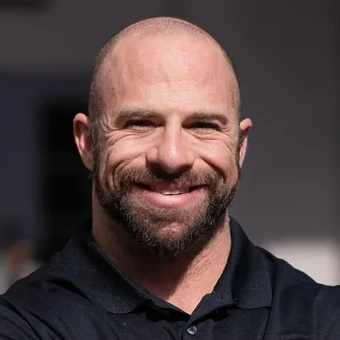
John Jewett is an IFBB Professional bodybuilder and physique coach, and the founder of J3 University. He has spent his career competing at the professional level while coaching competitors and everyday lifters through the same training, nutrition, and recovery principles he uses himself.
J3 University exists to make that process teachable. Every course is built on the reasoning behind the method, not just the method, so you can make better decisions about your own physique long after the program ends. The article above is drawn directly from the J3U course curriculum.