You need both knee flexion and hip extension, because one head of the biceps femoris only crosses the knee. That means a lying leg curl for the fully shortened position, a seated leg curl for the fully lengthened position, and a stiff leg deadlift as the hip hinge. If you only ever hinge, you never fully develop the hamstring, and the head you miss is the one that gives you the drop in a rear shot.
Everybody wants hanging hams in the side shot and guitar strings down the back of the leg. To get them you have to know what the muscle does, so we can pick movements that cover the full range.
There are four main muscles back there. The semitendinosus and semimembranosus cross the hip and the knee. Moving more lateral you have the biceps femoris, which has two heads. One head crosses the hip and the knee, so it functions in hip extension and knee flexion. The other head only crosses the knee.
That single detail decides your exercise selection. If you only did hip extension movements, you would not fully train the hamstring. And when you look at a stage shot, that big hamstring dropping down, the part that hangs, is the biceps femoris. So you have to go through good knee flexion movements to train that lower aspect and get the drop.
The hamstring starts fully lengthened when the hip is flexed and the knee is extended, and it is fully shortened when the hip is extended and the knee is flexed. That is a very full range, and the three movements below are how you cover it.
| Movement | Joint position | Where it loads the hamstring |
|---|---|---|
| Lying leg curl | Hip extended, knee flexing | Fully shortened |
| Seated leg curl | Hip flexed, knee flexing | Fully lengthened into mid range |
| Stiff leg deadlift | Hip hinging, knee soft | Fully lengthened |
The lying leg curl exists to train the shortened end range, with the hip extended and the movement happening at the knee. Everything about the setup protects that.
Start with the machine. Find the rotating cam and make sure your knee aligns with it, so you are not creating binding forces and you are not limited in how far you can flex the knee.
Then set the torso before you move. You almost crunch down into the leg curl. If you relax you will see an arch appear in the lower back, which is anterior pelvic tilt, and that will follow you through the set. Lower the pad down onto the hamstrings and keep it tight, because you want the hips locked and the knee locked so nothing shifts.
The critical cue is keeping the hip down against the pad. If the hip comes up you are lengthening the hamstring at the hip joint, which defeats the entire purpose of the exercise. Then drive the knee up into the pad to initiate the movement, go all the way into knee flexion, and control it back out.
For the feet, line up ankle to knee to hip at roughly shoulder width. Keep a slight internal rotation at the hip, with the knees and feet pointing straight down. Do not try to target individual hamstring heads with foot rotation. They relatively share one origin and insertion, so chasing heads just lowers your output. Get in the position that creates the best tension instead.
People bring up the glute ham raise here, because from a visual standpoint it looks like a lying hamstring curl. It loads the movement the exact opposite way you want.
It is really heavy in the fully stretched position. Then as you pull up and shorten the hamstring, your body moves away from 90 degrees to gravity, so it actually gets lighter as you rise. By the time you are fully straightened and the hamstring is fully shortened, you have lost load on the muscle entirely.
So the glute ham raise is not a programming replacement for the lying hamstring curl. If you want load in the shortened end range, use a machine whose pegs let you load there, or a kneeling single leg hamstring curl as a substitute.
The seated leg curl moves you from the fully shortened position to the fully lengthened one, so between it and the lying curl you have gone full circle on the hamstring: from hip flexion with the knee extended, all the way to hip extension with the knee flexed.
If I had to name one hamstring curl to keep, it would be this one. You train the hamstring fully lengthened, you hit a good mid range as well, and it has a lot of stability and bracing built in, which matters if your control is poor.
Setup follows the same logic. Align the machine's pivot point with the knee so there is no binding and no limit on knee flexion. Bring the pad down onto the upper thigh and set it tight enough to block the position, because all you want to do is bend at the knee. No hip flexion or extension should be happening at all.
The bracing is a counterforce. When you curl, the hamstring wants to lift you up out of the seat, so you oppose that by driving down and back at around a 45 degree angle. Foot position is a slight internal rotation to neutral, ankle to knee to hip in line.
Go slowly into the descent. If you drop into the bottom, momentum pulls the hip in the wrong direction as the eccentric starts. That is why I suggest a pause in the bottom position, so you are not bouncing out of a stretch reflex and losing the position you set up.
Hip hinges are a large compound movement for the whole posterior chain, so the question is which one, and that depends on what you are training. The four to choose between are the conventional deadlift, the sumo deadlift, the stiff leg deadlift and the RDL.
The sumo deadlift I would rule out for hypertrophy. You end up at a very good mechanical advantage: hips close to the bar, torso upright, knee right above the ankle, and it cuts the range the hip has to move through. The conventional deadlift is better because the hips can travel further back, but the hamstring still is not changing length much, because as the knee bends the hip bends with it.
That leaves the stiff leg deadlift and the RDL, and the difference between them is relative knee bend and hip travel. The stiff leg keeps a very soft knee and lets the bar drift away from the shin, which biases the hamstring. The RDL uses more knee bend and keeps the bar closer to the shin, which brings in a lot more glute. So for hamstring development, the stiff leg is the one you want.
Note the word soft. We are not truly keeping a stiff leg. A muscle that is fully lengthened cannot produce much force, and the same is true fully shortened, so a slight knee bend is what keeps the hamstring able to produce force. A fully locked knee also puts you in a precarious bottom position.
Start from the ground. Use a shoulder width stance. Going wide only starts limiting your range of motion. For foot angle, slight internal rotation to neutral, which preloads the glutes and hamstrings. Do not turn the feet out, because that shortens the glutes up.
Keep the hips relatively over the ankle. When the hips do not push back, the glute is not being lengthened, so it is not much of a contributor and the tension stays where you want it.
Find the end range from the bottom. When you reach the fully lengthened hamstring, going any further is all lumbar flexion. That is your stopping point, and it is a good visual for anyone learning the lift.
The complaint you will hear is feeling it in the lower back, and it comes down to bracing. Cue pushing away, but also rib cage down, crunch the abs, and press the lower back against the support. What happens otherwise is people bring the chest up and lose rib cage over pelvis, the hips rotate anteriorly, you lose range out of the hamstring and you finish with a lower back pump instead.
Be aware there is real erector loading in this pattern by nature, because the load sits farther out from you. That is a consideration for whether you need it, not a fault in the exercise.
One honest note on why the body fights you here. Most people try to anteriorly rotate the pelvis because it puts the hamstring in a stronger position to lift the load. Your body is looking for the mechanically advantaged spot. In bodybuilding we are doing the opposite: finding the hardest way to move the load. That is why the cues exist.
A 45 degree back extension can put you in a position that loads a lengthened hamstring, but the loading on it is extremely limited in terms of driving real tension through that lengthened position. So it is not a substitute for the stiff leg deadlift as your compound pattern early in a session.
Doing stiff leg work out of a pit shark has the same problem. It has a better application as an RDL than as a hamstring focused hinge.
And you do not strictly have to hip hinge at all for hamstring development. Between a lying leg curl and a seated leg curl you are already reaching all the points the hamstring functions through. The hinge is there because it loads a lengthened hamstring under real load, which is where a lot of hypertrophy happens.
If you keep one, keep the seated leg curl. It trains the hamstring fully lengthened, hits a good mid range, and has enough built in stability that you can brace and produce force. But it does not replace a lying curl, which is the one that loads the fully shortened position.
A lying leg curl plus a seated leg curl already covers the points the hamstring functions through. A stiff leg deadlift is there because it loads a lengthened hamstring under heavy load, which is valuable, but it is not compulsory for hamstring development.
Stiff leg. The difference is relative knee bend and hip travel: the stiff leg keeps a soft knee and lets the bar drift off the shin, which biases the hamstring, while the RDL uses more knee bend with the bar close to the shin and brings in a lot more glute.
Bracing. If the chest comes up you lose rib cage over pelvis, the pelvis rotates anteriorly, and you lose hamstring range while the erectors take the work. Cue rib cage down, crunch the abs, and press the lower back against the support.
No. The hamstring muscles relatively share one origin and insertion, so trying to bias heads with foot rotation mostly just lowers your output. Keep the foot close to straight up and down in a fairly neutral position without a lot of rotation either way, and chase tension instead.
X-Frame runs a hamstring focused leg day as one of its session types, so the curl and hinge work on this page sits inside a structure with real progression rather than being bolted onto the end of a quad session.
Explore X-Frame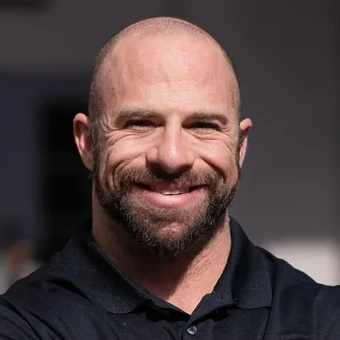
John Jewett is an IFBB Professional bodybuilder and physique coach, and the founder of J3 University. He has spent his career competing at the professional level while coaching competitors and everyday lifters through the same training, nutrition, and recovery principles he uses himself.
J3 University exists to make that process teachable. Every course is built on the reasoning behind the method, not just the method, so you can make better decisions about your own physique long after the program ends. The article above is drawn directly from the J3U course curriculum.