Quad training comes down to three patterns: a squat, a leg press and a leg extension. Pick the squat pattern that lets you drive the knee over the toe without the hip travelling away, which for most people means a pendulum squat first and a hack squat second. Set your feet as low on the leg press platform as you can while keeping full foot contact at depth. Finish with a leg extension, which loads the quad fully shortened on its own and reaches the rectus femoris your squats barely touch.
You want a quad sweep, so start with what the muscle actually does. The quadriceps is made of four muscles. The vastus medialis, the intermedius and the lateralis all cross the knee joint to extend the knee. They do not cross the hip joint, so they have no involvement in hip flexion or hip extension.
The fourth head is different. The rectus femoris also crosses the hip, so it extends the knee and flexes the hip. That single fact is why quad training is not just knee extension. You have to train the quad in hip flexion as well, or one of your four heads never gets properly loaded.
Three movement patterns cover that full functional capacity: the squat, the leg press and the leg extension. Get all three right and you develop the whole quad.
| Pattern | Its job | Where the quad is loaded |
|---|---|---|
| Squat | The biggest bang for the buck | Lengthened, under the most load |
| Leg press | Knee travel with stability | Lengthened into mid range |
| Leg extension | Isolation, and the rectus femoris | Mid range into fully shortened |
Start about shoulder width, with the toes straight out or slightly pointed out. Which one depends on your movement capacity and what lets you get into the bottom position best. There is real variability here, but it has to pass one test: the stance has to let you drive the knee over the toe.
What we do not want is someone widening into a sumo based stance to try to bias the quad. That does the opposite. Out of the gate you get a lot of expansion of the knees and a lot of adductor involvement, you lean forward with the hip travelling back, and you end up with a vertical shin angle at the bottom and no knee travel over the toe. That is a glute and adductor squat wearing a quad label.
If your hips travel away from the bar, that is a setup problem with known fixes. A slight heel elevation helps, and so does anything that moves the centre of mass forward, like a safety squat bar. The cam on a safety bar sits more anterior, so you can stay upright and keep driving the right position without limiting your loading. For a taller lifter with a long femur, heel elevation plus a safety squat bar is probably your best chance at real quad emphasis from a free squat.
Ideally you are starting with a pendulum or a hack squat. Both serve a dual purpose: you get maximal knee travel across the toe without the hip moving away, because the back pad supports you and externalises stability, so output stays as high as possible.
The pendulum squat is the number one pick. It allows a lot of knee flexion, you are braced, and the hip swings down into it so you are not fighting pelvic tilt. The hack squat is next, because it puts the knee really far away from the hip and heavily biases quad development. Its line of force runs through the shoulders and the hips, so there is very little glute contribution.
The hack squat asks a lot of your ankles. It requires a great deal of knee flexion and a lot of dorsiflexion, which is a problem for taller lifters. If someone has their feet high on the platform because they lack ankle mobility, move the feet down and add a heel elevation instead. If the platform angle itself is too steep and it is not adjustable, that hack squat may simply not be the right machine for that person, and they should be moved to another squat pattern.
If free weights are all you have, a back squat with those alterations works. A Smith machine squat is more fixed, so you get more bracing, and you can hold safety straps out in front to help. What I would leave out entirely is a V squat. The way it is mechanically built pushes you away from keeping back pressure into the pad the deeper you go, so it is not a good opportunity to train a quad.
One warning on the hack squat. A lot of people run reverse bands on it. As you reach the bottom the band tension slingshots you out of the hole, which removes tension exactly where the muscle is lengthened and has the best ability to match the strength curve. I am not for reverse banding, because it takes away the best part of the lift. The exception is someone who does not have control in that deep position: use it to slow the descent and find the groove, then progress off it. Same thing if you are coming back from an injury and should not be loading the quad fully lengthened yet.
The leg press is your chance to output at a very high level from a fixed position. Pull your hips down into the bottom of the seat and pull the rib cage down at the same time to create that pressure brace, using the handles at the side to pull yourself down.
Foot position decides whether this is quad work. Get the feet as low on the platform as possible while still keeping the foot in full contact with the platform when you reach depth. Take a shoulder width stance with the toes pointed slightly out or straight, whichever is comfortable. A slight turnout lets you cue the big toe on the way down. If you notice your toes rising at the bottom, move the feet up the platform slightly and that solves it.
Foot pressure is the same as a squat. Drive down to the big toe as you descend so you gain full access to your range of motion, then blow the air out and drive through the mid foot to push the platform back up.
There is a hip room problem that catches people. With the hip sitting low relative to the platform, hip flexion often runs out before dorsiflexion does. An easy fix is to put a block under your seat so the hip sits a little higher relative to the platform, which usually buys enough room that dorsiflexion becomes the limit again.
One structural flaw worth solving: a leg press is easiest at the top, which is why people can load absurd weight on it. Adding bands that pull down on the platform matches the resistance profile to the strength of the quad, so you get more out of every rep.
A pendulum leg press is my number one pick. As you push out on the platform the load comes away and higher up, so it loads the strength profile well as the quad gets short. A 45 degree leg press is the second pick, and adding bands mimics some of what the pendulum does.
A Cybex style squat press is third. Its arc drops down toward the hips, which lets you get a lot of knee flexion without as much demand from the hip, but the load swings down and drops off at the very bottom. That is a real trade off, since loading the lengthened position is great for hypertrophy. Personally I would rather someone get full range of motion at the quad even though it unloads a little at the bottom.
The vertical leg press I would completely rule out, for the same reason I would not use a high and wide foot position. It will not take the knee through the full range of motion to train the quads, and you are starting from a lot of hip flexion already.
While we are here: people put their feet high and wide believing it hits hamstrings. You will feel a little stretch in the hamstrings at the beginning, but as the knee flexes and the hip flexes, the hamstring is not really changing length that much, and the tension you feel is coming from somewhere else. It is not a good way to train hamstrings, and it limits your range in general.
For a unilateral pattern, and especially when there is a discrepancy between one leg and the other, the best quad setup is a split squat with the back foot on a bench and some slight heel elevation.
Putting the back foot up moves the pendulum so more weight sits on the front foot, which means more tension on the front leg. That is the whole reason to pick it over a stationary lunge or a front foot elevated version. The heel elevation then drives even more knee over toe.
Set the base of support so stability is external rather than something you have to produce. You have three points: the front foot, the back foot on the bench, and the bar you are holding. Same cues as the squat, rib cage down, descend, drive the knee over the toe, find that bottom position.
This pattern also trains the rectus femoris in its fully lengthened position, which is exactly the head your squats are least likely to be reaching.
The leg extension is the isolation movement and the end of the quad session. It is very braced and not very systemically taxing, so you can drive a lot of extra stimulus with it. It is also the only place you truly load the quad fully shortened.
You do get shortened work when you lock out on presses and squats, but there the ankle, knee and hip stack in line, so force runs through the whole chain. The leg extension loads the quad short on its own. It also activates the rectus femoris, which you will not see trained much in a squat pattern.
Setup starts with the machine, not with you. Line your knee joint up with the pivot arm of the machine. If you are not aligned there you may get knee pain, or you will find your hips shifting forward or out. Then adjust the seat so you can keep your hips back against the pad.
Brace so the movement does not pull you out of the seat. Keep the hands slightly in front of the torso, because hands behind you invites you to pull your chest up and lose the brace. Rib cage over pelvis, grip down, brace hard, and let the knee joint be the only thing moving.
If your machine has adjustable loading, load the middle for the mid range, and load the top position too. The top of a leg extension is usually the easiest part while being the hardest place to contract the quad, so loading it matches the resistance to the quad's strength profile.
One more fix, and it is a common one for bigger lifters. If your feet end up really turned out when you sit into a leg extension, go single leg so the ankle, knee and hip line up straight and the pad drives force straight into the shin. That twisting angle into the shin is what causes a lot of people's knee pain. I have had medial knee pain myself, so almost all of my leg work is single leg.
A squat pattern that lets you drive the knee over the toe with the hip staying supported. For most people that is a pendulum squat first and a hack squat second, because the back pad externalises stability so your output stays high while the knee travels.
No. A sumo based stance does the opposite. You get knee expansion and adductor involvement, the torso leans forward with the hip travelling back, and you end at a vertical shin angle with no knee travel over the toe. Stay around shoulder width.
As low on the platform as you can while still keeping full foot contact at depth, about shoulder width, toes straight or slightly out. If your toes lift at the bottom, move the feet up slightly. If you run out of hip room before ankle range, put a block under your seat.
Yes. You do train the shortened phase whenever you lock out on a squat or a leg press, but there the ankle, knee and hip stack in line. The leg extension loads the quad short on its own, and it activates the rectus femoris, which barely gets trained in a squat pattern. Put it at the end of the session where it is not competing with your heavy work.
Generally no. The band tension slingshots you out of the bottom, removing tension exactly where the muscle is lengthened and best matches the strength curve. Use it only to help someone control a deep position or to work around an injury, then progress off it.
X-Frame is the hypertrophy program built around the frame itself: sweeping quads, wide lats, capped delts and a small waist, with the session structure and progression these setups belong inside.
Explore X-Frame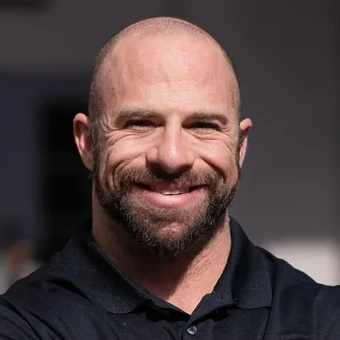
John Jewett is an IFBB Professional bodybuilder and physique coach, and the founder of J3 University. He has spent his career competing at the professional level while coaching competitors and everyday lifters through the same training, nutrition, and recovery principles he uses himself.
J3 University exists to make that process teachable. Every course is built on the reasoning behind the method, not just the method, so you can make better decisions about your own physique long after the program ends. The article above is drawn directly from the J3U course curriculum.