Upper back work is a pull down where the elbow finishes high rather than tight to the body, a chest supported overhand T bar row as the primary builder, and a shrug for the trap fibers the rows do not finish. What separates upper back training from lat training is the scapula. For lats you keep it quiet, and here you deliberately train it through full protraction, elevation, retraction and depression.
The upper back is what gives you thickness up top in a rear lat spread and detail in a rear double. It is not one muscle. Working from the outside in you have the rear delts, then the traps and rhomboids, the teres major, and some lat function as well.
Here is the distinction that decides everything. When we train lats we are not cueing much scapular movement, because the lat is not attached to the scapula. In upper back work we are, and deliberately. You want to train those scapulas through their full range of motion to get full development out of the traps and the rest of the upper back musculature.
You have probably never heard of an upper back pull down, because everyone calls them lat pull downs. But when most people do a pull down they flare the elbows out, which is not a lat pull down at all. The elbow finish point is what decides which one you are doing. Down and tight to the body finishes on the lower lat fibers. Higher up in the back is upper back.
| Movement | What it trains | Where it loads |
|---|---|---|
| Upper back pull down | Traps, rear delts, scapular range | Through full scapular range |
| Chest supported overhand T bar row | The whole horizontal plane | Heaviest lengthened, tapering |
| Shrug | Upper and middle trap fibers | Elevation and retraction |
| Kelso shrug | Mid traps without the arms failing first | Protraction to retraction |
Start with alignment. For an upper back endpoint you want to reach a position where the elbow finishes higher across the back, not driven down against the ribs.
The cueing runs in a sequence. Let the scapulas travel fully up into the top of the range, then depress the scapulas, then drive the elbows back and down. That gets the scapulas into a fully depressed and retracted state, which is what trains the traps and the rear delts. As you let the weight out, cue pulling the bar apart to keep the back engaged, and at the top make sure you reach full protraction with some elevation.
Two setup details. At the bottom, the elbow should be around 90 degrees so you are not biasing the bicep. And if someone is too flared out to reach full range, having them lean back slightly more gives them a little more adduction and opens the range up.
For grips, a variable width adjustment with a slight bit of pronation works well, for the same reason it does everywhere else: it lets you match the handle to the person instead of the person to the handle.
A row is the primary developer for the back, and this is the row. It moves into a different plane to challenge the fibers horizontally, which encompasses the rear delts, teres, traps and rhomboids all at once.
There are two reasons we prefer it over a bent over row, and both are worth understanding rather than taking on faith.
First, the chest pad. A bent over row is a hip hinge, so the erectors are bracing throughout the entire movement. That makes them a rate limiter on the output you can produce through your upper back, and they are not creating any counterforce that would help you produce more force. The chest pad removes that ceiling.
Second, where the load gets hard. A bent over row with a barbell or dumbbells gets really heavy in the shortened position. The overhand T bar is most valuable in the stretch position, and we want that full protraction so we are loading the lengthened position of the row in this plane.
The main execution error is going too far into flexion over the chest pad, letting the chest come up off the pad and the movement run into lumbar flexion. That usually traces back to the chest pad height being set badly, and the consequence is you have to use momentum to get back to neutral and start the rep. Keep the central hub braced and stop at full protraction. If you have longer arms, this will pull you forward more, so the pad height matters even more.
The cue I like is pinky pressure: driving the hands out on the handle to create tension through the rear delt and teres before you even pull. Locking in the grip that way, on top of a braced torso, helps drive the elbow path into the shortened position.
The ideal piece for this overhand rowing plane is an overhand prime extreme row, because the peg adjustability lets you distribute the load according to the strength curve. We load about 60% of that load on the top peg, with peg three loading the lengthened position the heaviest, then about 40% in the middle peg and nothing in the bottom, so the load tapers through and you can really get into the shortened position.
That is a rare piece of equipment, so the overhand T bar row is the second option and the one most people will use.
People ask about an overhand cable row as a third choice. It carries a lot of the same limitations as the overhand barbell row, so it is not a replacement for the chest supported setup.
If you train at home with dumbbells and an adjustable bench, set the bench to an incline and run the same setup. It is not as ideal, because it gets really hard in the shortened position, but you keep the chest support and the plane.
After the pull down and the row you have hit lower and mid trap fibers. The shrug is where you get the upper and middle trap fibers without a lot of contribution from the rear delt and teres major.
Fiber arrangement decides the direction. The trap fibers run from the cervical position out to the scapula, so a straight up shrug is not moving in line with them. You want a line of force in the plane those fibers actually run in, which is around 45 degrees.
That is why the ideal setup is dual adjustable cable arms, so the line of force runs straight out along the fibers. A loaded barbell or dumbbell sends force straight down, which does not line up. There is a second problem with a fixed barbell: the internal rotation it puts you in does not align well with the trap fibers, which need the scapula slightly retracted to line up properly.
Take the full contractile range. Scapular elevation and retraction, then fully allow the scapula to protract and depress. Cue the arms slightly in front of the torso so the line of force wraps down along the fibers.
The last one is the Kelso shrug: protraction and retraction without the rowing component. It exists for a specific problem. If your rear delts or biceps fail before your traps do, you never get the mid trap development, and this lets you use everything the traps have without those muscles being the limit.
The elbow path and the scapula. For lats you keep the elbow tight to the body and do not cue much scapular movement, because the lat does not attach to the scapula. For upper back the elbow finishes higher across the back, and you deliberately train the scapula through elevation, retraction, protraction and depression.
For upper back development, yes. A bent over row makes your erectors brace throughout, which becomes the rate limiter on your output, and it loads heaviest in the shortened position. The chest supported overhand T bar row removes that ceiling and loads the stretch, which is where it is most valuable.
Usually you are going too far into flexion over the chest pad, with the chest coming off the pad and the movement running into lumbar flexion. That is normally a chest pad height problem, and it forces you to use momentum to start the rep. Set the pad and stop at full protraction.
Yes, for the upper and middle trap fibers, once you accept that a straight up shrug is not moving along the fiber direction. The traps run from the neck out to the scapula, so you want a line of force around 45 degrees, which is why dual adjustable cables beat a loaded barbell.
Protraction and retraction without the rowing component. It is the fix for when your rear delts or biceps fail before your traps do, so you can develop the mid traps using everything they have rather than stopping when your arms give out.
Applied Hypertrophy Optimization covers upper back and lat training as separate disciplines, with the alignment, apparatus and loading standards behind every choice on this page.
Explore Applied Hypertrophy Optimization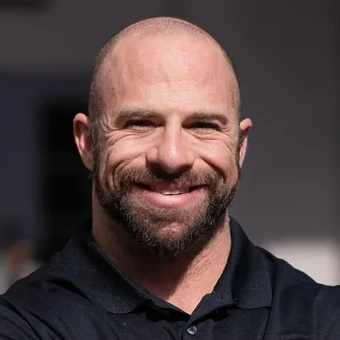
John Jewett is an IFBB Professional bodybuilder and physique coach, and the founder of J3 University. He has spent his career competing at the professional level while coaching competitors and everyday lifters through the same training, nutrition, and recovery principles he uses himself.
J3 University exists to make that process teachable. Every course is built on the reasoning behind the method, not just the method, so you can make better decisions about your own physique long after the program ends. The article above is drawn directly from the J3U course curriculum.