The gastrocnemius crosses the knee, so it needs a straight leg movement, and the soleus attaches below the knee, so it needs a seated one. A standing or donkey calf raise covers the gastroc, a seated calf raise covers the soleus, and an anterior tibialis raise covers the front of the lower leg. Keep a soft knee rather than a locked one on standing work, and do not train calves before squats, since everything around the ankle contributes to your stability there.
Calves get neglected, which is a shame, because it is one of my favourite body parts to train. Full development takes three muscles, not one.
The gastrocnemius runs along the back of the lower leg and attaches to the Achilles tendon. The important part is that it comes up and crosses the knee joint, so it acts in plantar flexion and also in knee flexion. That is why a bent knee changes what you are training. It matters most for your back double, your rear lat spread and any shot from the rear.
The soleus sits deep to the gastroc with the same attachment on the Achilles, so it also contributes to plantar flexion, but it attaches below the knee joint. There is no knee flexion action from the soleus. When someone gets really lean the soleus is prominent from the side, so it contributes to side shots and to giving the calf girth.
The anterior tibialis runs along the front of the shin, insertion on the first metatarsal at the big toe, wrapping a little around the lateral aspect of the tibia. It pulls the toe toward the shin in dorsiflexion. Think of it as the bicep of the lower leg. You would not train triceps and skip biceps, so do not train the back of the calf and skip the front.
| Movement | Knee position | What it biases |
|---|---|---|
| Standing or donkey calf raise | Soft, nearly straight | Gastrocnemius |
| Seated calf raise | Bent | Soleus |
| Anterior tibialis raise | Either | Anterior tibialis |
The straight leg variation is where you get the gastroc, and the biggest cue is not to actually lock the leg straight. Keep a soft locked in knee.
The reason is leverage. With a fully straight leg the gastroc is grabbing along the femur without a good leverage point to work from. Bending the knee a little creates a moment arm for the gastroc to work on the femur, so it can leverage and actually function.
Get the hips far enough forward, which is a common thing to miss and it keeps the calf properly biased. Then drive the ankle forward as you shorten the calf, take it all the way up into the shortened position, and control the way back down.
Two execution problems to watch. People lean back and pull on the machine handles to leverage the weight up, which makes it easier and quietly removes the work from the calf. If you hold the handles, do not pull them toward you. I would rather see the hands on the thighs, or on the seat depending on the setup.
The other is overshooting the bottom. If you go far beyond your range the toes start to pull up, which removes the brace from your toe and limits output, and then you need momentum to start the next rep. Find where the bottom of your calf raise actually is and use it as a cue.
A standing calf raise that loads on the spine has a scheduling problem more than a technique problem. If you do it on leg day after squats, your core is already fatigued, so you limit output on the calves and accumulate more systemic fatigue by putting all that load through the spine.
The donkey calf raise is the better movement choice, because you load from the hip down to the ankle and take away the loading required through the torso. My preference is a donkey calf raise for exactly that reason.
No donkey machine is not a problem. You can do the same thing on a leg press. You have good hip stability there, so you can focus on moving at the ankle joint only.
And there is nothing wrong with a standing calf raise itself. Just pick the right day for it, one where you are not coming off leg day, like a pull session.
The seated calf raise is where we take the gastroc out of it. With the knee bent, the gastroc is close to a point of active insufficiency, so it is so shortened that it cannot produce as much contraction and its influence drops. That biases the soleus. Everything attached to that ankle joint still contributes to plantar flexion.
Setup is mostly about the knee pad. Get it tight on the top of the thighs, and make sure the knees are stacked directly over the ankles or slightly toward mid foot. Too far back or too far forward and the force coming through the knee pad does not align into the ankle, which is a poor application of force and can cause knee problems.
The cues are the same as the standing version. As you shorten the calf, drive that ankle forward, get into the shortened range, and control the eccentric. Drive the big toe up into the pad, rotate all the way up into the full contraction, control the way down, and take the full range of motion.
An anterior tibialis raise is not in every gym, but it belongs in full calf development. Set up in an anterior tib brace if you have one available.
The efficient way to program it is to superset a seated calf raise into an anterior tib raise. Neither movement is very taxing, so the pairing costs you almost nothing in fatigue and saves time.
There is a second benefit. Both movements are a good opportunity to work through functional ankle mobility and to strengthen the end ranges around the ankle, which pays off in everything you squat and hinge.
Everything that surrounds the ankle contributes to the stability and bracing you need in squat patterns and hip hinges. So the one thing you do not want is to fatigue all of it before that work.
That leaves two sensible slots. Put calves on an upper body session, or put them at the end of leg day. Be honest about the trade off at the end of leg day: you will have quite a bit of fatigue and you may not generate a lot of great stimulus.
For the biggest visible size, prioritise the gastrocnemius, so a standing or donkey calf raise is the primary movement. The seated calf raise supersetted with the anterior tib work is the secondary block.
A donkey calf raise, because it trains the gastrocnemius, which is the biggest visible part of the calf, while loading from the hip down to the ankle instead of putting all that load through your spine. Pair it with a seated calf raise for the soleus.
The knee. The gastrocnemius crosses the knee joint, so a bent knee shortens it toward active insufficiency and it cannot contribute much. That is why a seated calf raise biases the soleus and a straight leg raise biases the gastroc. You need both.
No, keep a soft locked in knee. With a completely straight leg the gastroc is grabbing along the femur with no good leverage point. A slight bend creates a moment arm so the gastroc can leverage against the femur and actually function.
Not before squats or hinges. Everything around the ankle contributes to your stability and bracing in those patterns. Put calf work on an upper body session, or at the end of leg day accepting that fatigue will limit the stimulus you can generate.
If you want full lower leg development, yes. The anterior tibialis is the bicep of the lower leg. Superset an anterior tib raise with your seated calf raise, since neither is taxing, and you get functional ankle mobility work out of it as well.
Applied Hypertrophy Optimization walks through calf training alongside every other body part, with the anatomy, setup and programming standards this page is drawn from.
Explore Applied Hypertrophy Optimization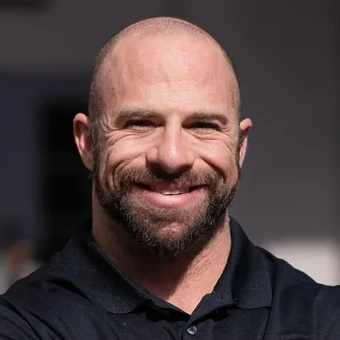
John Jewett is an IFBB Professional bodybuilder and physique coach, and the founder of J3 University. He has spent his career competing at the professional level while coaching competitors and everyday lifters through the same training, nutrition, and recovery principles he uses himself.
J3 University exists to make that process teachable. Every course is built on the reasoning behind the method, not just the method, so you can make better decisions about your own physique long after the program ends. The article above is drawn directly from the J3U course curriculum.